
There are neighbourhoods that are worth visiting.
And then there are neighbourhoods that you eventually come to feel are your own.
Trastevere It falls into this second category.
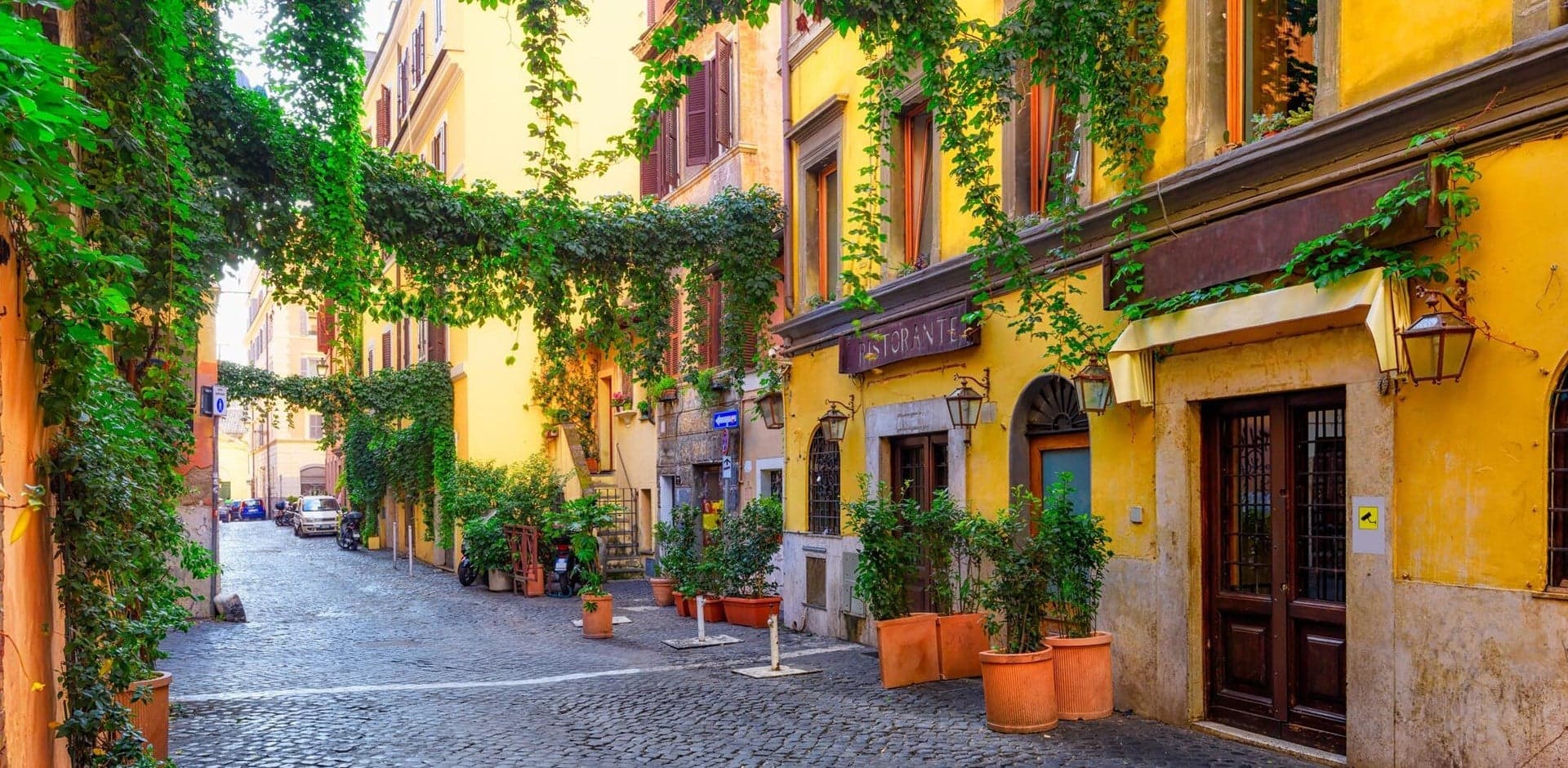
You only have to cross the Tiber to realise that something has changed. The streets narrow, the buildings draw closer together, the cobblestones guide your steps, and the city takes on a warmer, more spontaneous, almost homely feel.
Here, Rome seems to do more than simply preserve its history.
It seems he’s still living through it.
A neighbourhood made up of little details
The charm of Trastevere is rarely to be found in sweeping views.
It’s in the details.
A half-open shutter.
The ivy climbing up a façade.
A small square I stumbled upon by chance.
The clatter of plates coming from a trattoria.
The afternoon light casting its glow on the walls of an ancient building.
It is an imperfect, authentic beauty that cannot be replicated anywhere else.
And that is precisely what makes the neighbourhood so distinctive.
Two souls, one identity
Trastevere changes dramatically throughout the day.
The morning still belongs to the locals, the markets, the neighbourhood cafés and the streets that are slowly filling up.
In the evening, everything changes.
The squares become meeting places, lights spill out from the restaurants, voices echo through the alleyways, and the neighbourhood reveals its liveliest side.
For some people, this energy can be intense.
But Trastevere isn’t the sort of place you go to for complete silence.
It should be chosen because Here, the city is always present, even when you close the front door.
A deeply human Rome
Perhaps this is what sets Trastevere apart from many other areas in the city centre.
It never seems quite monumental.
Even when standing in front of an ancient church or a historic building, there is still something everyday about it, something lived-in.
A bicycle leaning against a wall.
The tables outside a bar.
An open window.
Someone waving hello from across the road.
This is a Rome that is not merely to be observed.
Invite people to take part.
Living between the Tiber and the Janiculum
The location adds yet another element to its charm.
On one side is the Tiber, on the other the slopes leading up to the Janiculum. A little further on lie the historic centre, Campo de’ Fiori, the Tiber Island and some of the city’s most beautiful walking routes.
And yet Trastevere retains such a strong identity that it almost feels like a city within a city.
Every street has its own atmosphere.
There are areas that are bustling until late at night and others which, just a few metres further on, suddenly become quiet and cosy.
It is precisely this diversity that makes the neighbourhood difficult to summarise.
Houses that tell the story of Rome
Even the houses seem to contribute to the character of the neighbourhood.
Historic buildings, flats tucked away behind unassuming doorways, small terraces overlooking the rooftops, exposed beams, inner courtyards and windows looking directly out onto the alleyways.
They are often not perfect spaces.
But they have something that a new building is unlikely to offer: a story that has already begun.
And living here means, in a way, carrying on writing it.
Trastevere doesn’t try to be perfect
And perhaps that is precisely why it is so fascinating.
It’s noisy and cosy.
Popular and sought-after.
Timeless and incredibly contemporary.
He doesn’t try to hide his contradictions.
He transforms them into his identity.
Because Trastevere is not just one of Rome’s best-known neighbourhoods.
It’s that part of town where all you have to do is step out of your house, round the corner, and still feel as though something might happen.