
There are places in Rome that captivate visitors with their beauty.
The Jewish ghetto It strikes a chord on a deeper level.
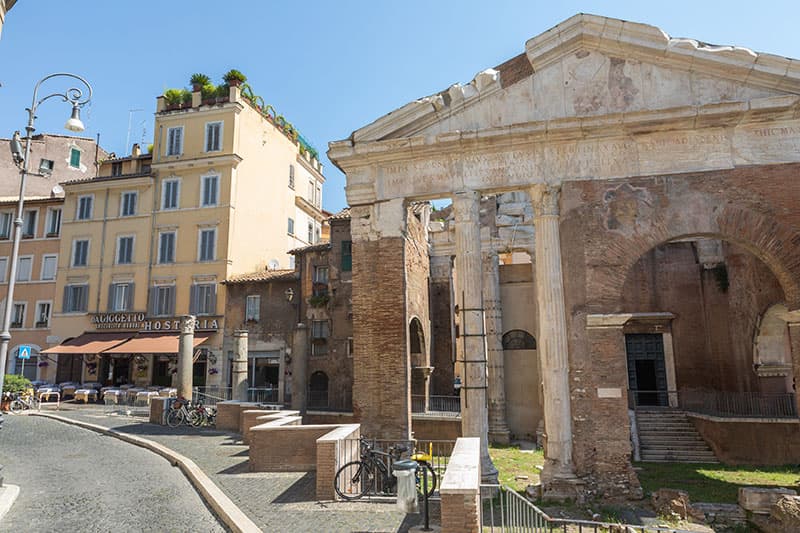
Here, every street seems to bear the marks of time. The Portico d’Ottavia, the ancient façades, Piazza Mattei, the Tiber just a short distance away: it all contributes to creating an intimate, intense, almost suspended atmosphere.
The Ghetto is situated in the Sant’Angelo District, the smallest in Rome, opposite the Tiber Island. Established in 1555, it is one of the oldest Jewish ghettos in Europe and, for over three centuries, was a place of enforced segregation for the Roman Jewish community. Tourism in Rome
Today, it is one of the places where the city’s history is felt most keenly.
A beauty that is not merely aesthetic
Walking here means travelling through different eras in the space of just a few metres.
The Roman ruins of the Portico of Octavia, rebuilt by Augustus between 27 and 23 BC, stands alongside Renaissance palaces, narrow alleyways and the silhouette of the Great Synagogue. Rome Tourism
Then there are Via della Reginella, Piazza delle Cinque Scole, Via di Sant’Ambrogio and Piazza dei Cenci.
Roads that don’t need spectacular views to be charming.
All it takes is a lit-up window, a little table outside, the sound of footsteps on the cobblestones.
A Rome that is also reflected in its flavours
The Ghetto is also one of the places where Rome best illustrates its relationship with food.
The Jewish-Roman tradition has left a very strong culinary identity: artichokes alla giudia, salt cod, anchovies with endive, and ricotta and sour cherry tarts are still an integral part of neighbourhood life. Rome Tourism
They aren’t just traditional dishes.
They are a form of memory passed down through the generations.
And this, too, is what makes the neighbourhood so special: here, history, everyday life and tradition continue to coexist in the same space.
A place to be treated with respect
However, one cannot describe the charm of the Ghetto without acknowledging its most painful history.
The 16 October 1943 The neighbourhood was the scene of the large-scale round-up of Rome’s Jewish population by the Nazis. Even today, the stumbling stones in front of some houses commemorate the names and lives of those who were deported and never returned. Rome Tourism
It is an unobtrusive presence, yet one that is impossible to ignore.
Perhaps this is precisely what sets the Ghetto apart from many other parts of the historic centre: its beauty does not erase what happened there.
He keeps it.
The charm of feeling as though you’re in the heart of Rome
Despite its very central location, the neighbourhood retains a surprisingly intimate feel.
On one side lies the Tiber Island; a little further on are the Capitoline Hill, Campo de’ Fiori and the Theatre of Marcellus. Yet, as you venture into its innermost streets, the city seems to narrow suddenly.
Everything feels closer.
More humane.
More intimate.
It’s the sort of Rome where you can head out without a specific destination in mind and let the street decide where to go.
A story that continues
The Ghetto is not a neighbourhood stuck in the past.
It is still a vibrant place today, deeply rooted in the Jewish Community of Rome, one of the oldest in Europe, whose history in the city predates the very establishment of the Ghetto by many centuries. romaebraica.it
And this is perhaps its most fascinating feature.
It doesn’t look like a museum.
It is a memory that continues to have a voice, a cuisine, families, traditions and everyday life.
Because there are neighbourhoods that tell the story of Rome through its monuments.
The Ghetto is told through the stories of the people who lived through it, suffered in it, preserved it and carried on living there.